

Cream as a Technology
A cosmetic cream is an engineered material: two liquids that refuse to mix, forced into a stable, spreadable structure that must survive years on a shelf.
The basic idea is old. The first cold cream is usually credited to the Roman-era physician Galen around 150 CE, who worked water into molten beeswax and olive oil; versions of the recipe were still in the London Pharmacopoeia of 1618 (Cosmetics and Skin). Nivea put it on industrial scale in the beginning of 20th century.
What a cream actually is
Technically, a cream is an emulsion: tiny droplets of one liquid dispersed in another liquid it cannot dissolve in, held there by an emulsifying agent. Emulsifiers are molecules that lower tension between the two phases (Herbal nanoemulsions review, PMC).
A cream is a system that is widely used for active ingredients transport in cosmetics and topical medicine. In both cosmetics and medicine, the cream base called the "vehicle". A 2024 dermatology review:
"The fundamental purpose of a dermatologic vehicle is to serve as a carrier for active drugs." — Ahuja, An & Lio, Skin Pharmacology and Physiology, 2024.
The same emulsion technology is therefore used for a day cream, a sunscreen and a prescription cream from the pharmacy. What differs is the active ingredient and the regulation that applies to it (see "Safety, preservation and regulation" below).
There are two basic architectures:
- Oil-in-water (O/W) — oil droplets in a continuous water phase. Most serums, day creams and lotions are built this way; all the textures that feel "lighter".
- Water-in-oil (W/O) — water droplets in a continuous oil phase. W/O systems feel "richer" and "more protective". Used for night creams, masks, ointments.
Which phase ends up continuous is not decided simply by which ingredient is present in the larger amount. An industry primer stresses that the emulsifier system, not the oil-to-water ratio, largely determines the emulsion type (Cosmetics & Toiletries).
The difference between a serum, a lotion, a cream and an ointment is mostly one of viscosity and water content: serums and lotions are thin emulsions, creams are semi-solid emulsions, and ointments are largely water-free fatty bases such as petrolatum.
The building blocks
A typical cream has 15–30 ingredients, but each falls into a few functional classes. A standard O/W test emulsion used in one skin study shows the proportions: 20% oil, 3% wax, 8% humectants and 1.5% surfactants, with water making up the rest (Analysis of electrical property changes of skin, PMC).
These ingredients fall into two groups. A few are actives, which serve for the effect promised on the label. All the rest are excipients – water, oils, waxes, emulsifiers, thickeners, preservatives and pH adjusters – and together they form the base of the cream. Most excipients have no cosmetic "effect" of their own to advertise: their job is to build the oil-water emulsion, keep it stable over the whole shelf life and keep it microbiologically safe. The 2024 vehicle review describes the core of every emulsion as "the oil phase, the aqueous phase, and the emulsifier", and notes that the water phase is what makes preservatives necessary (Ahuja et al., 2024).
Actives usually make up only a small share of the formula. There is no official "average" figure, but typical use levels show the order of magnitude. The EU limits retinol to 0.3% in face and hand products and 0.05% in body lotions, and alpha-arbutin to 2% in face creams (Commission Regulation (EU) 2024/996). The classic clinical study of niacinamide used a 5% cream (Bissett et al., 2005), and urea moisturizers are usually formulated below 10% (Rajkumar et al., 2023). Taken together, actives in most creams account for roughly 0.1–10% of the weight, while the excipient base makes up the remaining 90% or more.
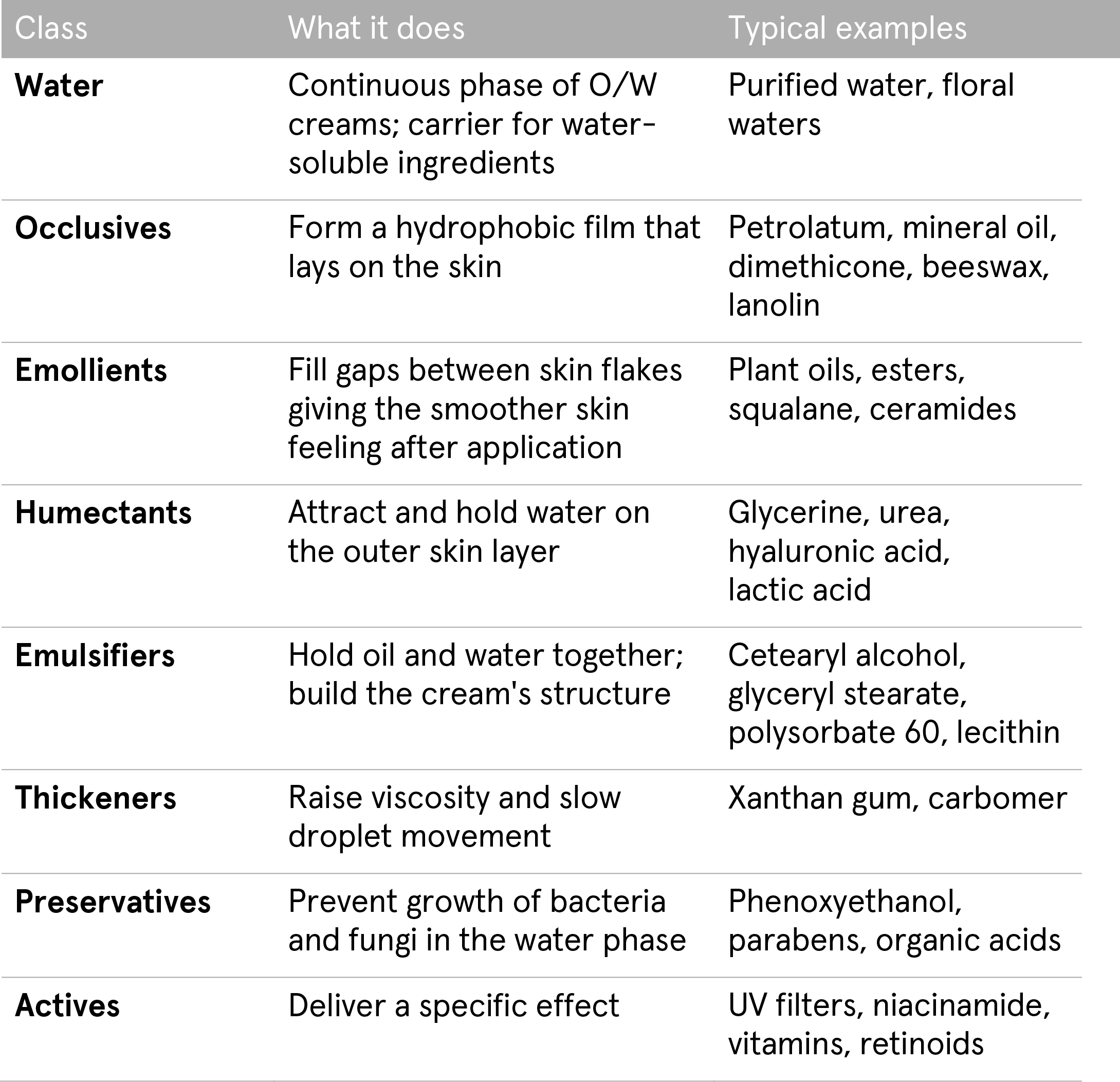
Sources for the table: DermNet, JCAD — Update on Moisturizers, Rajkumar et al. 2023.
One review of moisturizer cream technology puts it this way:
"Humectants promote water retention within the SC (Stratum Corneum), whereas occlusives generally minimize water loss." — Moisturizer technology versus clinical performance, PubMed.
The pairing matters: a 2022 review notes that humectants used without an occlusive can actually increase water loss from damaged skin in dry air (Cosmetics, MDPI).
The engineering problem: keeping it stable
An emulsion is never truly at rest. Left alone, oil and water want to separate: droplets rise or sink (creaming), merge (coalescence) and finally split into two layers. A cream has to resist this for its whole shelf life.
Modern O/W creams solve this mainly with a lamellar gel network. Fatty alcohols such as cetyl and stearyl alcohol combine with a surfactant into stacked bilayers that trap water between them. This network physically holds the bulk water and oil droplets together and gives the cream its body (Lamellar Gel Network, ResearchGate).
Where the cream meets the skin
The cream's real target is the stratum corneum, the skin's outermost layer. It is often described as "bricks and mortar": flattened dead cells (corneocytes) embedded in a lipid matrix of ceramides, fatty acids and cholesterol.
How deep does a cream go?
Not very, by design. Dermatologists Jan Bos and Marcus Meinardi argued in Experimental Dermatology that a compound's molecular weight:
"must be under 500 Dalton to allow skin absorption." — Bos & Meinardi, 2000.
This is why DermNet warns that large molecules such as collagen and peptides cannot pass through the stratum corneum, whatever the label suggests (DermNet). For example, collagen has a molecular weight of about 300,000 Da, hydrolyzed collagen 3,000–6,000 Da, hyaluronic acid as used in cosmetics 5,000–1,800,000 Da, and a typical cosmetic peptide such as Argireline 889 Da – all well above the 500 Dalton limit (León-López et al., 2019; CIR, 2022; Acetyl hexapeptide-8, Wikipedia).
Safety, preservation and regulation
Water plus nutrients plus warmth is an ideal growth medium, so any cream with a water phase needs a preservative system. The formulator must protect the product against contamination in the factory and from fingers dipped into the jar for months. W/O emulsions are inherently less prone to bacterial contamination, because the water is locked inside oil droplets (Cosmetics & Toiletries). Preservatives themselves are a trade-off: the 2023 skin-barrier review notes evidence that some parabens may disturb the skin's microbial balance (Rajkumar et al., 2023).
In the European Union, creams are regulated as cosmetics, not medicines. Article 3 of Regulation (EC) No 1223/2009 sets the core rule:
"A cosmetic product made available on the market shall be safe for human health…" — Regulation 1223/2009, European Commission.
…under normal or reasonably foreseeable conditions of use. Before launch, every product needs:
- a designated Responsible Person based in the EU who answers for compliance;
- a safety assessment by a qualified assessor, recorded in a Cosmetic Product Safety Report;
- a Product Information File kept available for authorities;
- notification through the EU Cosmetic Products Notification Portal (CPNP).
The regulation has applied in full since 11 July 2013 (Food Research Lab; UK government guidance). The line between cosmetic and drug is drawn by intended purpose: a cream that claims to treat a disease, or that contains a medicinal active at therapeutic strength, becomes a medicinal product with its own approval route.
The takeaway
A jar of cream is a small feat of materials engineering. It is a metastable emulsion held together by an invisible gel network, made in a controlled heating and cooling process, protected against microbes and regulated for safety by law. A cream is a vehicle that is widely used for active ingredients transport in cosmetics and topical medicine. On the skin, its job is modest but real: to keep water in, smooth the surface and support a barrier that does most of the protecting itself. The best way to judge a cream is not by the promise on its label but by how well it does that job.
Filabé – modern advanced alternative
Filabé was invented to correct the flaws in traditional vehicle systems. To step out of old technology and bring active ingredient delivery on new level. Filabé's technology allows active ingredients to be delivered in their purest form, eliminating the need to create formulations around emulsions. Not supporting cream system for the sake of the system. Additionally, the microfiber technology provides soft exfoliation and cleansing in the same step, preparing the skin for the drug uptake.

Are you not sure which product
will fit your skin?


